
The Great Brickhill Coprolite Rush of the 1870’s
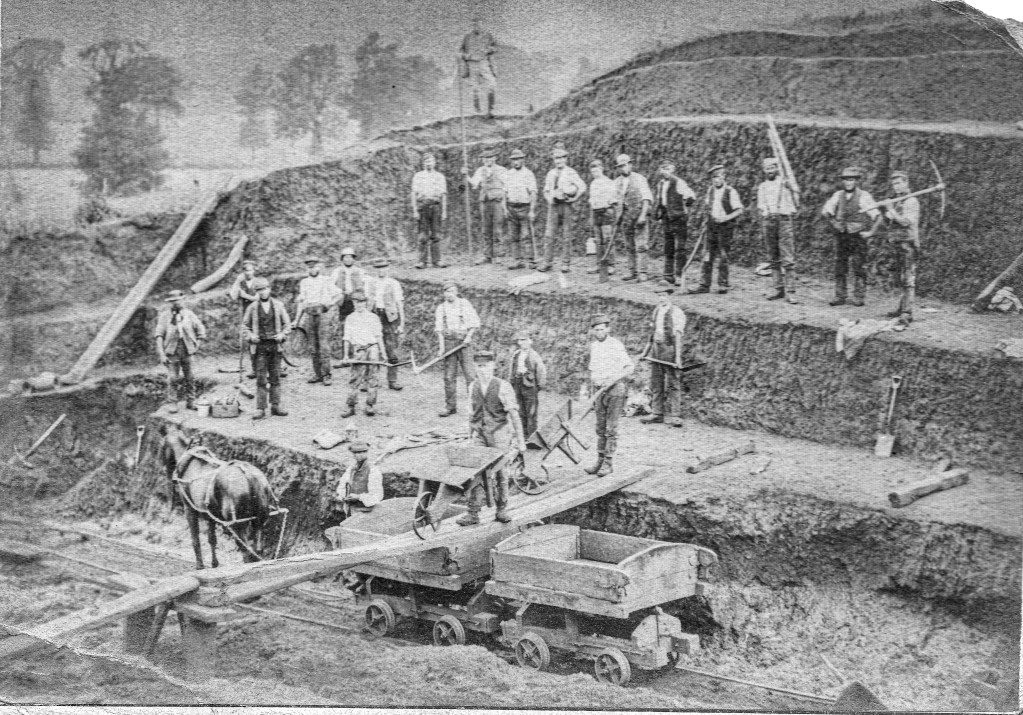
Great Brickhill through the ages has mainly been a farming community. Farm labouring was the main source of income in the village. However for a short time in the late Victorian period, another industry provided a lucrative source of income for many in the village.
In 1873 a Cambridge geologist, M.H. Teal whilst mapping in the area discovered phosphatic nodules in a sandy outcrop in the hill to the east of Galley Lane, close to the copse known as Philip’s Clump. It is behind the current (2022) Mucky Pups Nursery. Such nodules had been worked elsewhere in Bedfordshire and Cambridgeshire for some 30 years previously and were valued for their high phosphate content. This was a key component in agricultural fertiliser and worth around £7 per ton at the peak of demand. Ground to a powder and dissolved in sulphuric acid, the Coprolite nodules produced superphosphate – the first chemical fertiliser.
In the late Victorian era, enlightened by Darwin’s theory of evolution of species, many Geologists are actively exploring the Greensand for fossils. Remains of five dinosaurs were found amongst the coprolites in the Greensand. They included iguanodon, megalosaurus, craterosaurus, stegosaurus and dinotosaurus and fossil remains of marine reptiles ichthyosaurus, plesiosaurus and pliosaurus.
Coprolite, in its true sense, means fossilised droppings, and comes from the Greek words kopros, meaning dung and lithos, meaning stone. Many geologists disputed the coprolitic nature of the deposits and preferred to call them nodules but the term Coprolite was widely used across the Eastern Counties as a trade name.
The find caught the attention of the landowner, Sir Philip Duncombe. His land agent was employed to deal with the financial arrangements of its exploitation. In 1874 the Wolverhampton manure manufacturers, Griffin & Morris, were awarded the licence for extraction of the minerals. The following is a resume of the licence, held in the Buckinghamshire County record office.
“LICENCE FROM SIR P DUNCOMBE TO GRIFFIN & MORRIS IN 1874 TO DIG COPROLITES FROM PART OF HIGH THRIFT & BEGGARS PIECE. A TRAMWAY LAID FROM THE PITS DOWNHILL TO STOKE HAMMOND MEADOW ADJACENT TO CANAL. DIGGING CONTINUED TILL AT LEAST 1886 (FURTHER DETAIL, MAP & PHOTO OF WORKINGS) (B1-2).”
The land, [2022: behind Mucky Pups Nursery] some 14 acres in all, was leased from Sir Philip at £100 per acre per year, a considerable premium over the lease cost paid by tenant farmers. The land for a tramway to take the minerals to the Grand Union Canal and associated buildings for washing and processing was leased at a cost of £5 per acre per year. On top of this, and as proof that for a brief period at least, Coprolite extraction was highly profitable, the company would pay the tenant farmers a yearly rent for the land as compensation for the farmers’ loss of income from the land.
A photograph [above] copied from Michael Warth’s book GB in the 1800s was taken of the Coprolite working. It shows a terraced working face with some 23 men and boys posing with pick axes, shovels, wheel barrows and other paraphernalia of their trade. They are waiting to be loaded on a horse harnessed to two small trucks. The trucks ran on a specially constructed tramway which ran down the slope and crossed Galley Lane near the double bend. It then ran down to the river Ouzel [and presumably the Grand Union Canal] where the Coprolites could be sorted and washed for further transport by barge to Wolverhampton. There, it was processed and turned into phosphate based fertiliser. For those with a careful eye, the line of the tramway can still be seen from vantage points on Galley Lane, and also on Google Earth.
The original licence expired in 1881, and a further seven year licence was granted. However during this second licence period, domestic production of Coprolite based fertiliser took a big hit by imports. These were cheaper mineral based phosphates mined from large deposits discovered in North America and Africa. It seems that the Great Brickhill workings kept going through this period of decline longer than most. This was due to its proximity to the Grand Union canal, which meant that transport costs to the processing factory in Wolverhampton would have been lower than other workings along the Greensand and those in the Gault Clays to the South and East.
At the end of this second period, no further licence was sought and in the autumn of 1888 an auction was advertised in the Buckinghamshire newspapers. The auctioned items included plant and equipment from the workings, including a 22ft diameter water wheel, 4000 railway sleepers and 2 miles of track, plus a 6 HP steam engine. It is not known how successful this sale would have been as much of the equipment would have been highly specialised for Coprolite mining and production.
If any villagers have any photographs of the coprolite workings they would be willing to share on the village web site, please contact the us.
Chris Leech
Bernard O’Connor
Amongst other sources for this article, I would like to acknowledge Bernard O’Connor and his highly informative website containing information about our own Coprolite industry as well as others in The Greensand stretching towards the Beds/Cambs border. For those who wish to read further Bernard’s web site is https://bernardoconnor.org.uk where details of his book on the Bedfordshire Fossil diggings can also be found. Additionally Michael Warth’s book, Great Brickhill in the Mid 1800’s