
Introduction
Games of cricket have been played in Great Brickhill since the late 1800s. The Club has enjoyed the support of the Duncombe family throughout its history and has played cricket on the current ground since the early 1900s. The current ground is flanked by the Old Rectory and a pine-clad spinney and overlooks the Brickhill valley towards the River Ouse and Fenny Stratford. The Club over the years has fielded both junior and senior teams and enjoys some of the best cricketing and social facilities in the area.
Late 1800s to 1909
During this period, the cricket in Great Brickhill was played in the grounds of the Manor, which is home to the Duncombe family. The first recorded match was against Fenny Stratford Railway Temperance on August 18th 1886. The result was a 5 run victory to Great Brickhill. In this game the only person to reach double figures over two innings was a Mr C Fiennes, scoring 21 runs and he also took 7 wickets in the first innings. Mr J Ireland was reported for a fine bowling spell during the second innings taking 6 wickets for few runs. Between innings the teams would adjourn to the Duncombe Arms Inn for lunch.
Gifting by the Duncombe Family
1936 Sir Everard Duncombe gifted the original cricket pitch area to the Parish Council to develop as their cricket green.
1989 Sir David Duncombe gifted additional ground to the Parish council allowing the development of the tennis courts, nets and MUGA.
1994 Sir David gifted the area known as the Spinney to the Parish Council allowing the Cricket Club to enlarge its activities. This is the area where the Forest Hut now stands (funded separately through the work of David Bratt BEM).
From a discussion with Sir David Duncombe and David Marlow August 2022
1909 – 1915
In 1909 Great Brickhill Cricket Club relocated to the ground that it currently plays on today and shared the ground with the tennis club.
At this time the Club had 22 members with Sir E P Duncombe as President, Mr A Tooth was the Club Captain and grounds man at the new venue. The grounds man was employed at a cost of £2-10s (£2.50p) for the season, the tennis club paying 10s (50p) of the groundman’s fee. One of the Clubs rules was that the Club tent had to be erected and dismantled at the end of matches.
The first sight screens arrived at the club in 1910. Sir E P Duncombe donated the timber from his estate for the members to collect and construct. Gradually the Club grew and within the space of two years the Club’s membership had risen to 42 members, with the Club’s balance at £7-11s-3.5d (£7.56) and a season’s membership was 2 shillings (10p).
1911 saw Mr B Tooth top the batting averages with 17.6 runs, scoring a total of 210 runs in 14 innings (no bowling averages were recorded).
In 1912, when Mr S Fairburn became captain, training sessions were introduced twice weekly and it was agreed that club hats would be worn. Every year the opening match of the season would be between married men v single men on Easter Monday.
1915 -1918
There was no cricket played between 1915 and 1918 due to the 1st World War.
1918 – 1939
Following the end of the war the Club restarted playing cricket in 1919 with a membership of 26 and an annual subscription of 3s (15p). This season saw the club play 4 home games against Leighton Buzzard, Simpson, Billington, Stoke and ‘Ivy Leaf’ and 4 away games at Leighton Buzzard, Billington, Wavendon and Slapton). When playing away games the team would hire a horse and trap for the ‘umpire and scorers, the cost for this and tea was 4s (20p).
The Club in the 1920s needed to raise funds to enable them to pay for cricket equipment, score books, fixture cards, repairs and painting of sight screens, work to the pitch, repair of the mower, the umpire’s and scorer’s tea, transport to away games, carriage of equipment from the railway station and postage. Funds were raised from concerts, dances and whist drives as well as subscriptions and the sale of fixture cards.
From the early 1900s the Club provided cricket kit for the players and restocked from Gunn and Moore of Nottingham. The kit was sent by train from Nottingham to Bletchley station for collection.
The club’s assets in 1920 were recorded as follows:
- 1 cricket bag
- 2 cricket balls
- 3 pairs of gloves
- 4 pairs of pads
- 1 bat
- 2 damaged bats
- 1 set of stumps
- 1 tent
- 2 mowing machines
- 1 telegraph board
- 1 set of telegraph figures
In 1920 Stratton Park Boys School relocated from Biggleswade to Great Brickhill, in the grounds of the Manor. In 1920 Mr J W Clouston who was headmaster of the school became the club’s new president, although he was only in this position for one year. From this point the cricket field was shared between the club and the school.
During 1921 the Club became Great Brickhill Sports Club, because of the introduction of a football team that played in the Ascot League. However, the cricket club regained its autonomy in 1924 with Sir E P Duncombe again becoming its President.
In 1928 the club was in a healthy position with a balance of £102-12-1 (£102.60). There is a record in the Club’s accounts that a pavilion was built at a cost of £35 14s 6d (£35.72).
Throughout this period the under 16 year olds (U16’s) were playing, but in 1931 the club brought a junior cricket set to encourage the village youngsters to join the club. The following season, Sir E P Duncombe agreed to give a monetary prize to those U17’s who had the best batting and bowling averages as well as highest catches. Master R.S Turner was fortunate enough to receive the award for highest batting average and highest catches, collecting £1-5d. By this time it was agreed that the team would practice 4 times a week.
In 1933 the Stratton Park Boys School relocated to Brickendonbury (Hertfordshire) and the club had the ground to itself. In the same year fund raising was taking place at a larger scale. For the first time a comedian was contracted to entertain at the Club’s annual dinner and 100 tickets were sold.
1934 saw the Club accepting the tenancy of the cricket field from Sir E P Duncombe for a nominal annual rental of £1 and the right to sub-let the field for short periods for sheep grazing with any profits going to Club funds. Also, it was agreed with Mrs Jones the Head Mistress of the school that it could have full use of the Club’s facilities once a week for 45 minutes, providing they stayed off the square and keep to the junior practice wicket.
In 1936 Sir E P Duncombe donated the cricket field to Great Brickhill Parish Council for the use of sports activities and the provision for the erection of a single storey pavilion in the future.
In 1937 due to the growth of the cricket club a 2nd XI was formed.
1939 – 1945
There was no recorded cricket played during the 2nd world War.
1945 – 1976
On Tuesday 25th June 1946 a general meeting of Great Brickhill Cricket Club took place. The acting Chairman said:-
‘They were meeting that evening to decide to future of Great Brickhill Cricket. They had always been very proud of their village cricket team and it would indeed be a great pity if the grand old game of cricket was not once again started on the field which they had played for so many years. He personally thought that every effort should be made to get the game restarted as soon as possible in the village. He was quite sure that there was a real keenness amongst the younger members present and he did not think there should be great difficulty in getting a really useful team in the near future’.
After further discussion it was unanimously agreed that efforts should be made to restart the club. The committee for the 1946 season was made up of Mr C Tofield , Mr A Bates (captain), Mr W Dickens, , Mr C Walduck, Mr E Haycock, Mr R Hall (secretary) and Mr J Robinson (vice captain).
With the revival of the Club, funds were required, and in the summer of 1946 saw the organising of a village fete. A very impressive £136-12-10 (£136.64) profit was reported.
In 1948 prizes were still being given out to the winnings of averages etc the winning of the bowling average was a Mr. W Dickens who took over a 100 wickets in the season.
The club went on its first tour in 1949 with two coaches hired to take the cricketers and supporters to Bream in Gloucestershire. By this time the club now contracted a bus company to transport the team to all away games. Throughout the 1940’s (and 1930’s) the clubs main hurdle seemed to be the upkeep of it mowers and in 1949 it was reported that the club should collect it’s mower from H. Smith of Leighton Buzzard because it had be there for 2 years and had not been repaired.
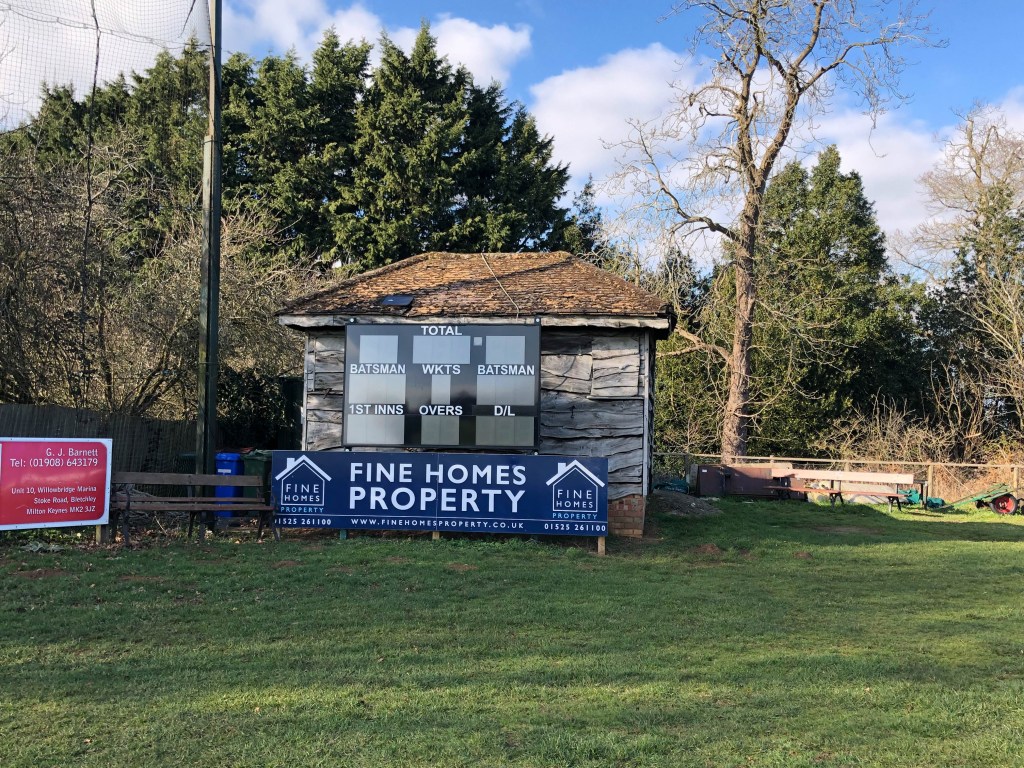
The current score hut at the far end of the field was built in 1950, by club members as the away team pavilion, following the clearance of some timber farm buildings. The home team continued to use the timber pavilion built at the time of the Stratton Park Boys School.
The horse drawn mower was replaced at this time by a Fordson tractor which was purchased at auction from Government surplus supplies.
In 1953 the club elected Mr T Snushall to become the Club’s first Chairman. In the following year Mr A Bates stood down as Club Captain after 8 years. He had done a great deal for the club and he continued to do so as secretary and the grounds man. He had done every job possible and without his efforts the club would have failed to exist after the war.
By 1957 enough of the members had cars, so the Club no longer needed to rely on the taxi’s previously provided to attend away matches.
In 1961 Mr R S Turner, of Rectory Farm became Chairman of the club after Mr Mckenzie was president for the previous two years.
A junior section was mentioned in 1965 and in 1969 extra fixtures were arranged to allow more juniors to play. In 1972 the club entered its first knock out cup competition which was held at Bletchley Cricket Club and was sponsored by Don Coleman. Until the early 1970s the Club only played a few fixtures on a Sunday and those that were arranged had to be complete by the 6pm church service. More regular fixtures now took place.
The Club’s President, Sir E P Duncombe died in 1972 after many years supporting the club and was succeeded by Sir P Duncombe who remained President until 1999.
1974 saw the Club practising during the winter at the cricket nets at Bletchley leisure centre.
The 1970s saw the Club decide to build a new pavilion and outline planning permission was obtained. Two options were considered, a free-standing building with full facilities and a second a similar construction connected to the village hall in Rotten Row. It was agreed that the Club should build a free-standing pavilion near the tennis courts.
In 1975 the club was struggling to raise enough money for the pavilion and local support for the pavilion was low. Different forms of construction were considered including and offer from Bletchley Motors of a steel framed, asbestos clad building as a gift. A pavilion was imminent; it was just a question of what type of building would be constructed.
1977
During 1977, after many years of fund raising, talking and planning the current pavilion, with a licensed bar was built and opened for the 1978 season.
1978
The pavilion was opened initially at weekends for cricket and on the Wednesday club night but due to demand of the cricket club members this was extended to every night, except Mondays and lunch times at weekends.
The opening of the pavilion acted as a catalyst for increasing the interest in the Club, both from the playing and social side. The success of the pavilion as a social meeting place led to further improvement in the facilities. The access from Lower Way was improved in 1979.
1980
In 1980 planning approval was granted to extend the pavilion to provide a separate kitchen, new ladies toilets and a room for cricket teas/ functions. This room later became known as Rupert’s Room, in memory of Rupert Brunt, a past Captain.
The cricket in the Club was also strengthening and for the first time since the war the club had sufficient members to field a Saturday 2nd team.
The Club recognised the importance of the introduction of league cricket for the development of the game of cricket and joined the local league.
1981
In 1981 the Club won the Beds and Bucks Border League and were considered to be one of the strongest village team in the area.
1983
In the season of 1983 to encourage junior cricket the Club entered an Under 14 team into Ampthill and District league.
This year also saw the players and social members run a half marathon around Great Brickhill, Little Brickhill and Stoke Hammond to raise money for Cancer Research.
1986
In 1986 Richard Turner stood down at Chairman of the Club to be replaced by his son Michael, who had been Club captain for the previous 10 years.
1989
The Club won the winter Milton Keynes Indoor Cricket league on their first venture in this form of cricket.
The strength of the cricket in the Club in the three seasons from 1990 to 1992 was shown with three Beds and Bucks Border League wins and two Cup wins.
1992
In 1992, the club formed a junior cricket section with the aim of giving local children the opportunity to learn, play and enjoy the game of cricket. Four senior players attended lengthy coaching courses and youngsters were invited to come along on Sunday mornings to have a go.
1993
The 1993 season was a milestone year for the Club. The popularity of the junior cricket and the enthusiasm of the all the players to improve the cricket at the Club led to the paid employment of a professional coach, Greg Thomas. Greg Thomas was a former fast bowler for Northamptonshire and an England test player. Through the 1993 season and for the following seven seasons Greg coached the junior and senior players and played for the 1st XI.
The commitment to provide professional cricket coaching placed a financial pressure on the Club which could only be met by outside grants / sponsorship. This started the Club on a path to gain grants / sponsorship from cricketing organisations, Local Authorities and local businesses, something which has carried on to the present day.
From early 1993, under Greg’s direction, junior cricketers attended indoor net session for the first time during the winter, and Club’s first ever junior teams, Under 12 & 14 joined the Milton Keynes and District junior League. The success of the junior coaching led to the coaching sessions taking place on three days of the week with friendly matches organised for all age groups as well as league fixtures.
The first junior success was achieved when an Under 15 side became the Milton Keynes & District League winners, and several juniors were strong
1995
The club, now firmly committed to organising and promoting junior cricket joined the Northamptonshire Cricket Association (NCA) for the 1995 season. Several juniors attended county nets throughout the winter and two were selected to play for Northamptonshire, one of whom was also selected to play for the Bedfordshire Schools Cricket Association. All teams performed extremely well in their first NCA season, with the Under 16 side being declared joint winners of the division having had their final rained off twice.
Also In 1995, saw a new Parish Hall built next to pavilion which gave the Club the opportunity to improve the facilities by building an air-conditioned cellar and a new away changing room. This led to the internal re design and improvement of the showers, toilets and home changing room.
1996
The 1996 season saw the Under 16s reaching the final of the NCA League and the Under 14s winning their league in an exciting final hosted by the Club. By now several juniors were playing regularly in the senior XI’s.
1998
The 1998 season the 1st XI joined the Ouse Valley league, after winning the Border County league 6 times in the last 8 years. The Club didn’t win the league, but they won the Premier Cup Competition.
2000
By the turn of the century the Club had lost a lot of the players that had been so successful in the 90’s, and now a very young Club team, which had graduated through the junior coaching was fending for itself in the premier league of the Four Counties Cricket League. After narrowly escaping relegation the previous 2 years, the club was relegated in 2003.
2004
In 2004 the Club side won the 2nd Division only losing one game during the season and was promoted back into the top league.
2005
2005 saw the Club take part in ‘cricket force’ a national event to improve grass root cricket facilities. It was on the ‘cricket force’ weekend the Club’s members constructed the decking at the front of the pavilion which now offers a great place to watch cricket on summer afternoons.
2006
The clubs first ever overseas player, Ashley Holloway from Tasmania arrived in 2006. Ashley proved a great influence amongst the Club and locals. When he wasn’t playing, he was working behind the bar at the George Inn. By now the Club was becoming a main contender in the top division and the young players that had struggled together since the early 2000’s were beginning to come of age. They had won the MK Sunday League Div 1 for the 1st time in an unbeaten season and also the Midweek League.
2007
2007 was to prove a great year for the Club on and off the field. Shannon Tubb (Ex Australian U19 captain) was to become player/coach and the team was also boosted by the return of Ashley Holloway for his second season. The first trophy won by the Club was the Leighton 6 a side tournament, which the Club had only won once before. On the last Saturday of the season the Club won Division 1 of the Four Counties Cricket League, beating New Bradwell by 9 wickets. The 1st XI ended the season unbeaten. The following day the team played Wolverton Town, needing to win to retain the MK Sunday league. Again, it was a comfortable win.
The junior fund-raising dinner and auction, held in October raised vital money for the Club’s ambitious plans to improve the cricket facilities. The success of this event has enabled the Club to, not only replace the existing artificial wicket but also provide the Club with an indoor cricket facility on Michael Turner’s farm for winter coaching for both senior and junior players.
2008
In 2008 the club joined the strong Cherwell League and was fielding a Saturday third XI.
Brian Wright Aug 2022