

This charming booklet was written and published by a very small team of villagers in 2002. We have a photocopied version and the full, transcribed, text that you can search and review at your leisure. The photocopied version is set out below the Table of Contents immediately below.
DM
Table of Contents of transcribed version;
Photocopied Version:
A Word From Our Editor
Thank you, so much, to all those who have contributed to this book, either by writing, or communicating verbally, their memories and past experiences.
The result is not intended to be an historic record of events, merely a trip down memory lane.
Title Page and Credits




Contents Page & Page Numbers
A Colourful Start 1-15
Memories from the Time of the Coronation of Queen Elizabeth II 16-35
Poetic Licence 36-40
Third London Airport Battle 41-44
Former Inhabitants 45-48
Photographs i-ii
High Ash School 49-50
School memories from children who are attending High Ash School today 51-63
A community to maintain 64-66
A Colourful Start
A WORD FROM THE EDITOR (of the original book):
As a forerunner to the memories, which many people have been kind enough to contribute, I have been asked to include the recollections of those who go back beyond three score years and ten. These elderly people did not want their names appearing in print but have painted a beautiful picture of life in Great Brickhill, as they remember it, and I feel very privileged that they have entrusted me to relate it.
Name the ancestors!

A Midwife, by the name of Nurse Laverick, who inhabited the far Lodge house, along Green End, was responsible for bringing many of the people, born around the 1930’s, into the world. She was also called upon, for
medical assistance, in the event of any minor accidents or ailments. Her main transport was a bicycle.
At this time, Green End truly depicted is name, with only a few of the older properties in existence. There was a large tree on the green, which had a hollow in the middle. The children had great fun, climbing in and using it as a place to hide, or to sit and play.
The gardens of nineteen and twenty one, Green End, were much smaller, ending at a dilapidated stone wall, a few feet behind the back of the houses. Number nineteen’s garden went side ways along the edge of the road where number 17 and 15 now stand. Behind these two cottages was a field, which was mainly orchard, where the children used to play. The houses had little picket fences and small wicket gates, which opened on to narrow paths, leading to the front door.
The thirty-mile an hour sign, for traffic, was situated by twenty-one, Green End.
When the telephone exchange was first built, it consisted of just the brick building. The ground surrounding it was cultivated with a wonderful show of mixed lupines. Such was the allure of these flowers that one employee asked permission to pick a bunch for his wife. It was their wedding anniversary; she must have had a sense of humour!
The field next to the telephone exchange housed a pond, which was full of newts. It would frequently flood.
One night, during a terrific storm, a large tree along the footpath, which ran through this field, was struck by lightening and split in two. It caused great excitement for the children.
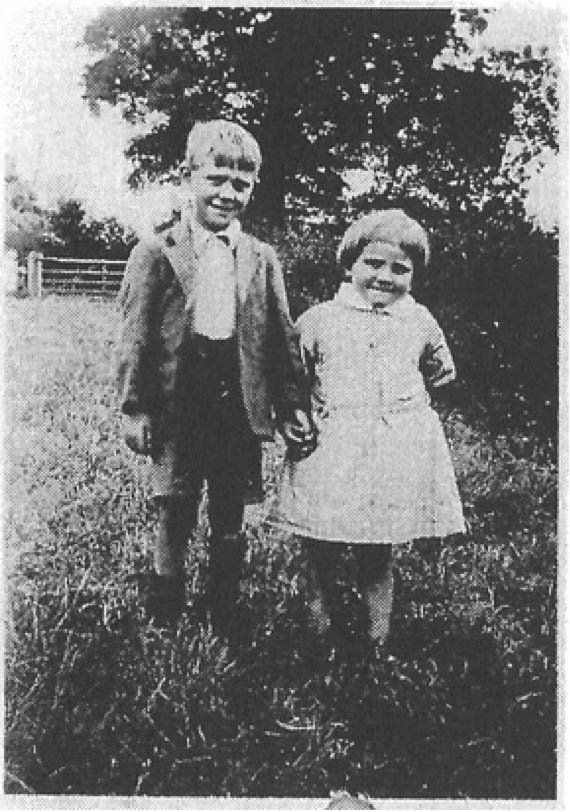
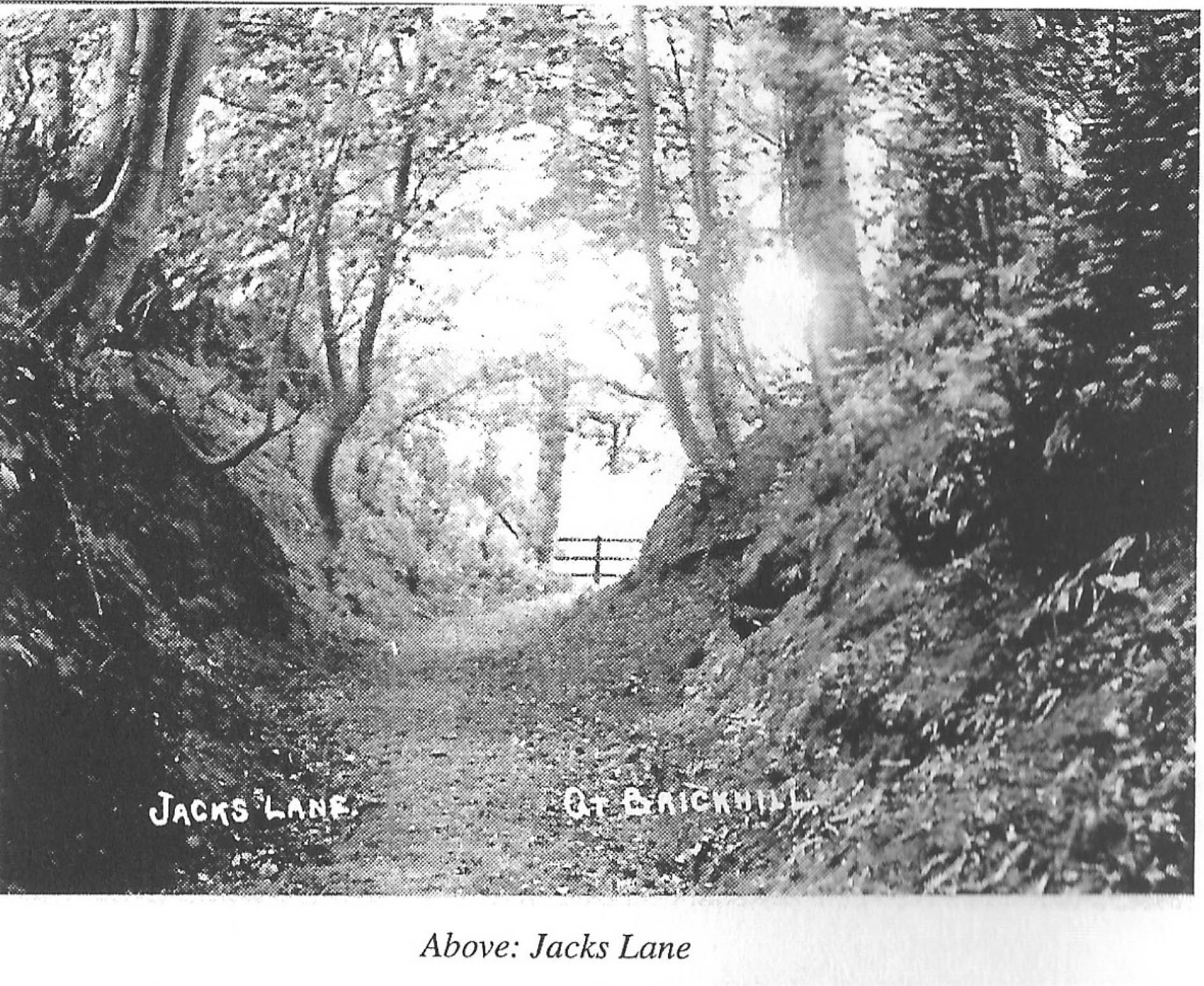
Jack’s Lane was cleared out, every year, by the men in the village, in order that the villagers could use it.
The photograph depicts how beautiful and tranquil it used to be.
Rotten Row used to be called High Ash. It had a green triangle at the top, which the traffic would go round. (This may give some encouragement to the people who are trying to sort out the school congestion). The narrow road, as it was then, was full of beech trees and hedges. Duck End was known as The Hollow and Pound Hill was called Chapel Hill.
Transport was very limited, with one bus a week on a Tuesday, to Leighton Buzzard market. The only other means of transport available, to most of the residents, to go in and out of the village was cycling. This meant that those who were employed out of the village had a daily climb back up the hills and must have been very fit.
To the excitement of the children, the ice cream man used to visit the village with his wares contained in the sidecar of his motor bike. The man sold Goldines ice cream and he came from Fenny Stratford. It is reported that he made his own product and kept the recipe a well guarded secret. Other ice cream men peddled up with a container on the front of their bikes. A barber used to visit the village on a horse and trap. Jimmy Gorman used to drive the school bus.
Each year, Sir Everard Duncombe and Lady Evelyn gave all the village children a Christmas party in the village hall. Sir Everard would show suitable films and each child would be given an apple and an orange as they left.
Some villagers kept pigs. Most small cottages had been built with this facility in mind and had a pigsty as part of the building. One of the slaughter men was Ron Giles. When the pig had been killed it would be placed in a lead bath, which would be situated in a barn, close to the house and salted every night.
Dances would be held in the village hall, often to the music of Mrs. Kempsley’s band, which came from Leighton Buzzard. Young people would also go to other villages, which were holding dances, transported by Ron Snell and Buckmaster’s buses. If the event was at Heath and Reach, they would usually walk. Even in the winter of 1947, the young people would walk down to Heath and Reach for these events. Some say that it was so cold that they could walk on top of the snow drifts. Occasionally, they fell in and just had their head showing, but there were others on hand to pull them out.
Girl Guides was held at the thatched cottage in Heath Road and was run by Miss Slipper and a helper. The Baptist and Methodist Churches were still open.
The school was situated on the corner of Lower
I Way and Pound Hill. The head master or mistress had a home in the middle of the school, with juniors one side and primary on the other, each with their own play ground. Children would go home for lunch. At eleven years old the children would progress to school in Bletchley.

When the evacuees came, in the war, two new teachers were recruited to deal with the swelling numbers.
Teachers remembered by people at school, between 1935 and ’45 are Mrs. Jones, Miss Penny, Miss Pocock and Miss Trouton. Miss Jeffs used to lodge at 19, Green End.
A German girl came to stay with Mrs. Jones in the war. Her name was Olga Wolfe. According to the inhabitants of that time, all the children mixed well together, which reflects greatly, the warmth of the people living here.
The cellar, underneath the garage, which was situated near to Butler’s shop, provided the air raid shelter for the school, during the war. Fortunately, the only bomb to fall on Great Brickhill fell behind the Methodist Chapel on Pound Hill, (which is now Chapel Cottage). Little damage was done with the exception of windows being blown out.
With great amusement, residents recounted the story of how the Home Guard saved the village, from the Germans, in the last war. Apparently, they were ready.
… guns (or broomsticks) pointing through the holes in the wall, up Manor Hill, stopping any travellers with the words,
“HALT! WHO GOES THERE?”
Fortunately, the enemy did not arrive……….. and Brickhill was saved!
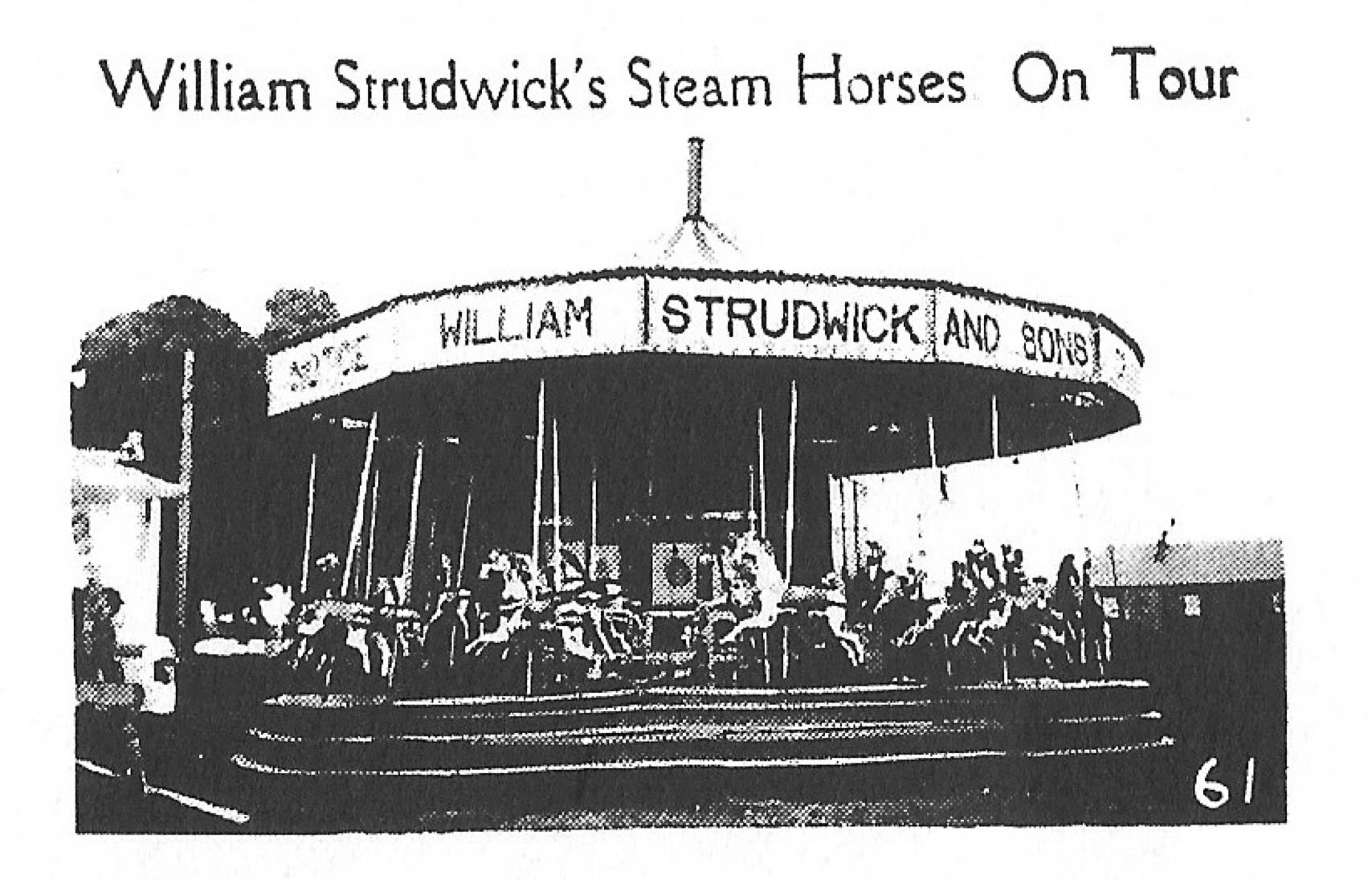
On 19th September, during the 1930’s and ’40’s, (except for the war years) the Brickhill Feast was held in the field opposite the Duncombe Arms. Mr. and Mrs. Strudwick and family, from Northamptonshire, came and set up the fair ground, which used to have a roundabout, swing boats, coconut shies and skittles. The equipment was pulled up to the village with a steam engine. Turning the hand of the hurdy gurdy, which a couple of the villagers, (usually Ted Haycock and Jim or Fred Dickens,) used to enjoy, produced the music.
On one occasion, the landlord of the Duncombe Arms pub, Frank Stabb, was feeling generous and decided to give all his customers a treat on one of the rides. To his relief, the particular ride had broken down and he returned to his occupation, wallet firmly in tact.
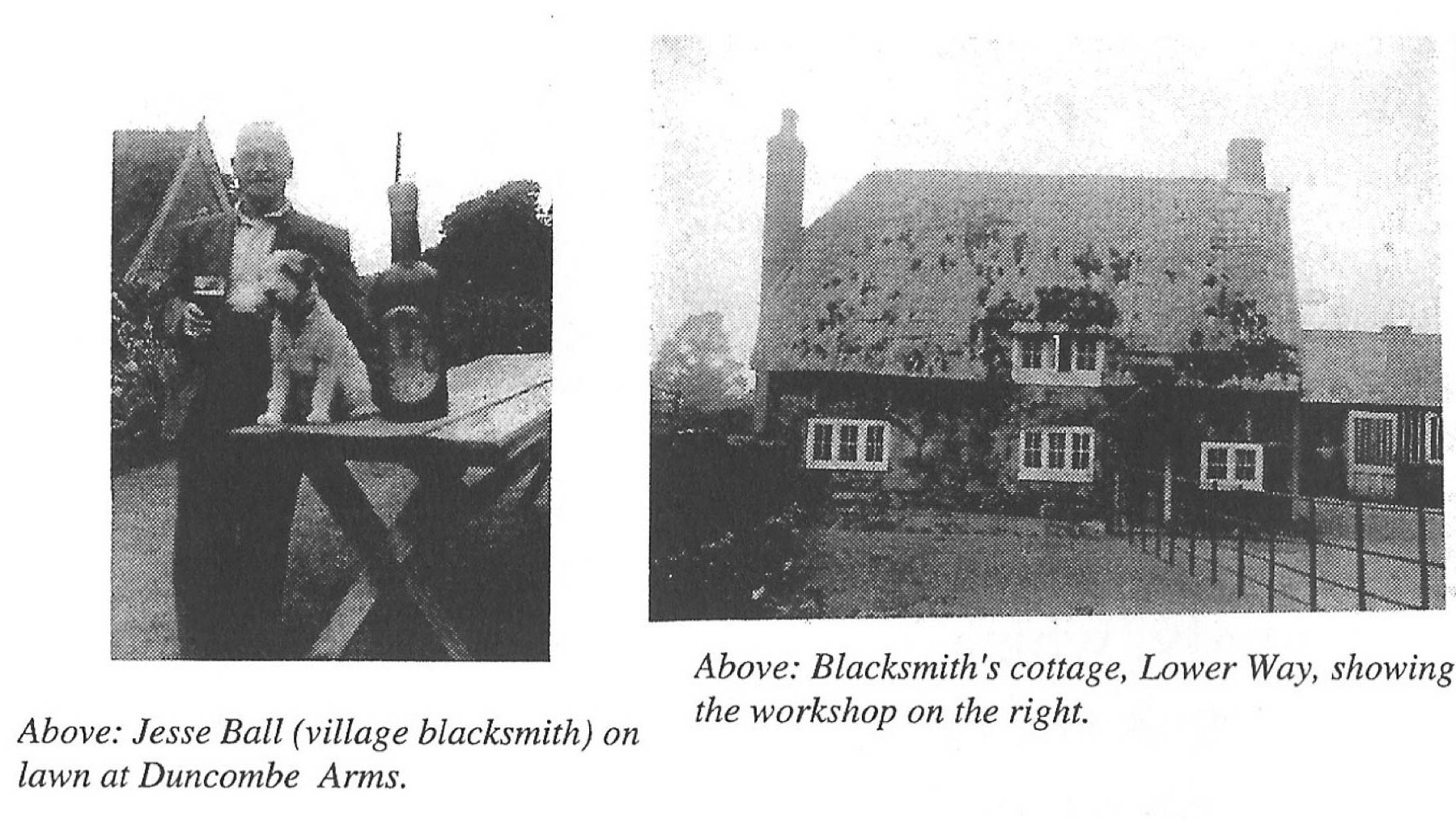
In 1945, in St. Mary’s Church, Thomas Strudwick, the Strudwick’s son, married Gwendoline Ball, daughter of the Great Brickhill village blacksmith, Jesse Ball. Mr. and Mrs. Strudwick still live in Roade, in Northants.

Before World War 2, the May Festival, which included the crowning of the May Queen, who was chosen annually, was held in the grounds of the old manor house. Elsie Russell became the May Queen when she was about 10 or 11 years old.
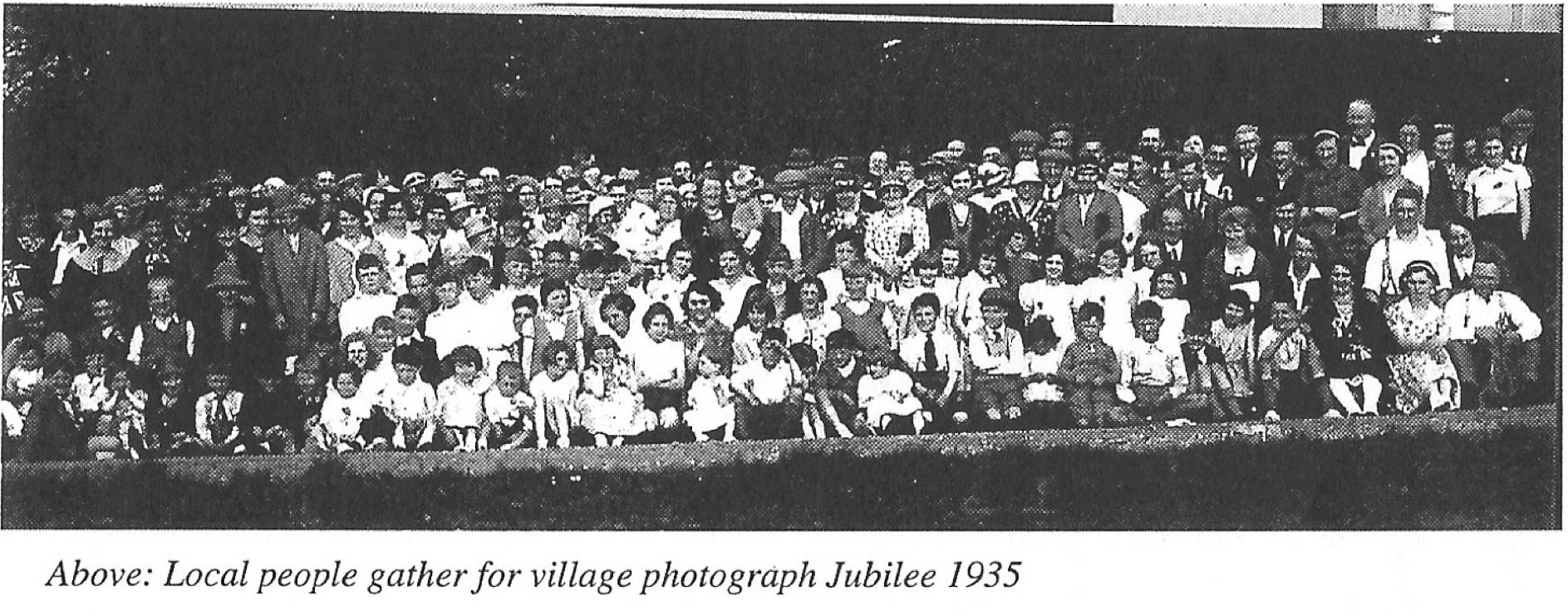
The celebration for the village, of King George V Silver Jubilee in 1935 was also held in the same grounds.
A wonderful poem exists about the Corporation muck cart. Over fifty years ago, most of the toilets were buckets and were emptied on a Friday night.
The Corporation muck cart was full
Right to the brim
When poor old Horace Gibbins
Fell in, and could not swim.
He sank to the bottom,
Just like a stone,
And all the little fishes sang,
There’s no place like home,
There’s no place like home.
Unfortunately, no pictures of the Corporation muck cart are available but there is a tune that goes with the ditty… if you can find someone who is willing to own up!
It is thought that the contents were emptied in the FoxHole, although this may be the imagination running wild, of the children at the time. However, after the evenings work, Horace Gibbins made his way to the Old Red Lion for some light refreshment. The village made sure that he had his own glass!
Many older people remember the weather being much colder during winter, in this village. This may be due to the lack of central heating which most of us, over the age of fifty, can easily equate with. Waking to windows covered in ice and our mothers telling us that Jack Frost had been, a trip to the bathroom, for those that had one, had to be endured, where as, a visit to an outside loo required great stamina, in the middle of winter.
1947 was a particularly bad year, with the village being cut off by snow. Eventually, Ivy Lane was dug out to give the inhabitants one route out of Great Brickhill and to allow Curtis’s milk floats to deliver their milk. Apparently, the snow lay for many weeks. Many houses were frozen up.
A beautiful scone depicted by Paddy Bennet, enables us to be enveloped in the atmosphere of the village as it was and probably had been for hundreds of years.
Paddy writes:
I am thankful for having known the village, when it was so peaceful, that the cows would wander past our gate, twice a day as they went to be milked. When you would walk down the lane on a warm summer’s evening and the lane would be full of glow-worms; when the swallows and the swifts would mark the seasons and the dawn chorus would wake you on a spring morning. Above all, the kindly old folk, especially our near neighbours, who were so much a part of the village.
EDITORS NOTE:
Let us not be lulled into thinking that all parts of life in the earlier part of the century were wonderful. I remember talking to Margaret Fairley, who died over a decade ago.
Moving from Scotland had been an exciting affair.
Margaret married at quite a young age and her husband, Jock, had taken a position as stockman in the village. The children came, hours of work were long and hard, money was short. Margaret was never able to see her mother again. Even in her mother’s last illness, there was no way that she could leave her children or finance a visit.
When one of her children became very ill, as a toddler, and was eventually taken into hospital, Margaret was unable to go with her, or visit. Later, the child died. Even fifty years later as she related this story to me, the pain of that loss became etched on her face. We cannot begin to imagine the harshness of such separation.
HAZEL HANKINS
I might well be the oldest inhabitant in Great Brickhill, as I was born at Rectory Farm in 1923. My memories are mainly concerned with the church where I was christened, confirmed and married, by the Rev. D. James who lived, at what is now called The Old Rectory, with his housekeeper, Miss Turner. The Sunday services were eight a.m., Holy Communion, eleven a.m., Matins, three p.m., Sunday school and six p.m., Evensong. Mr. James took all these services.
The village then was quite small compared with today, with about six cars, only, in the entire village. People used to walk, cycle, or use the bus once a week on Tuesdays, into Leighton Buzzard.
A funfair came, in the autumn, to the field opposite the Duncombe Arms public house, for about two nights with a round-a-bout and swings, loud music and toffee apples.
The village school was where the OAP bungalows are now, opposite Mr. & Mrs. Hugh Butler. We had a shoe shop run by Mr. Alf Curtis, and a garage where the milk lorries were kept which used to pick up the milk churns from the various farms, to take to Bletchley station.
Coronation of Queen Elizabeth II to Present Day
Marion Ralph
My memory of coming to Great Brickhill, forty-five years ago, was so favourable, that I wanted to stay forever. Apart from the lovely surroundings, the people were kind and neighbourly and there was a good community spirit. Two of my boys rather reluctantly sang in the church choir but greatly enjoyed the annual outing, (to Wicksteed Park, I think.) Life revolved around village activities, a smattering of dances, (some fancy dress) and barn dances.
Although there were only two buses weekly, one to Leighton Buzzard on a Tuesday and one to Bletchley on a Thursday, most of our wants were catered for by three shops (including Angela’s in Rotten Row in 1957), and quite a number of mobile shops, ranging from butchers, grocers, green grocers and bakers. Then of course, Mr.Langler’s bakery was open. His bread was delicious. Mr. Reid sold soft fruits (and picture frames!) and you could always buy fresh eggs and sometimes cream, (if you took your own jam jar), from a local farm.
I am thankful for all these things!
Editor’s Note
Some villagers remember Large’s small grocers shop down Rotten Row, where groceries were sold from the front room. Apparently Mr. Large also sold second hand cars. One inhabitant remembers buying an old banger for £8.
When I came to the village in 1970, I never paid more than £20 for an old car. I would use it for a year and then sell it on – often at a profit. One banger came looking the worse for wear, so I painted it rust colour. Not having mixed the paint properly, it looked like wood grain and over night every fly for miles sat on it and remained stuck. It came with a hammer, as sometimes, on stopping at traffic lights, the starter motor used to jam…but…I was equipped. Out of the car I would jump, hammer in hand, lift the bonnet – bang it and off we went! It caused a great deal of amusement for other drivers.
Peter Howson
I came to Brickhill on 29th September, 1959 when I was ten years old. I remember the beautiful, very warm late summer days in this quiet village, just off the A5 road. For a year, I went to the village school just opposite the Red Lion Pub. Here, I got to
know everyone in the village by their first name. Home Farm was arable and dairy with well kept hedges and trees.
Now, the village is not so quiet, mainly due to so many cars. Apart from a few people in Green End, I hardly know any one.
The new school was built in our field in the late ’60’s. Unfortunately, it has expanded and become too big and too noisy. It is spoiling the village. In the year of the high winds (about 1987?) at least fifty trees on our farm were blown down. Before this, Dutch Elm destroyed many trees. The latest are these hedge chewing animals..
.. horses! Ah well, it’s a living!
I am thankful for Home Farm Cottage (The Kennels), which was unliveable when we moved in during 1972. I have spent a lot of time and hard work doing it up. The cricket club and the new Parish Hall have improved the socialising of the village.
Bernice Brunt
My memory is of moving. Into Great Brickhill in September 1962 and the birth of my first son in November. Soon after this event, winter set in with very severe frosts causing the trees to sparkle.
On Christmas Eve, it started snowing. This was the heaviest snowfall I can ever remember seeing and heavy drifts closed many roads, in and out of the village. I believe that Ivy Lane was kept open by the milk lorries coming to the dairy in Lower Way. I felt very cut off with my new baby, not having lived here long enough to make many new friends… but it was very beautiful and lasted for weeks.
I am thankful for each day.
Editor’s Note
During this particularly hard winter, Fred Dickens was helping to unfreeze the Duncombe Arms. Unfortunately, he damaged his hand on the ice and ended up at Tindal Hospital.
Dawn Bigmore
When I was a child, my dad used to take my sister Julie, my brother Kevin and myself for a walk round the village every Sunday morning. We used to have fun, running through the woods, climbing trees, and picking flowers (for my mum) and building camps down Jack’s Lane.
I am thankful for the lives of my parents, Sheila and Ron.
Kay Willis
My memory is of a time before the convenience gas. I usually had about three to four deliveries of logs a month. The woodsman used to drive off, happily leaving a huge pile of logs at the edge of the road, outside the house! I then had the glorious task of carrying them and stacking them around the edge of the house.
About five minutes into the task, Di Baxter (Broomhill House) used to come out and lean on her balcony, watch for a few seconds, and then call out an invitation for coffee. If it was after 11.00 a.m. and it usually was, coffee became sherry.
A few glasses later, the task did not seem so bad, or the pile of logs so big!
Edna Bates worked for Di at the time. I miss both Di and Edna and will always be thankful for their friendship.
Tim Amies
A significant event for me, in the last twenty years, in Great Brickhill, was an invitation for our eighteen year old daughter, Sarah, to attend a Royal Garden Party, at Buckingham Palace, with my wife and I, from Sir Philip Duncombe. The weather looked doubtful and Sir Philip brought us to meet the Duke of Kent, saying he wanted to know if it was going to rain. (He wondered if I might have a “hotline” to God!) I said, “Yes, I do. It will not rain.”
It did not start raining until the Garden Party had ended, at 6.30 p.m. and we were walking back to our car. A very happy day for Sarah, Clare and myself.
Shortly after we arrived in Great Brickhill, in January 1978, we arranged to have our newspapers delivered by Arthur Bates – The Financial Times and Times, etc. After six months or so we enquired politely about a possible bill for these newspapers. Nothing happened.
Sometime later we once again gently enquired. In due course, Arthur Bates sadly passed away. At last, a bill of £438 arrived and was duly paid posthumously, with thanks for a most efficient service.
Dawn Haynes
I remember attending the old village school, at the corner of Pound Hill and Lower Way, for a couple of years. I have fond memories of the school dinners, (was I the only child who liked the semolina pudding?) However, I remember one particular incident when chocolate pudding with chocolate sauce was served. A nearby child, after a couple of mouthfuls, was sick everywhere, (a coincidence I am sure, but for some years afterwards, I would refuse chocolate pudding, convinced that it made people ill. We were very fond of the dinner ladies who doubled up in the playground. I especially remember Mrs. Toadfield and Mrs. Robinson, who we nicknamed Mrs. Robbie Dobbie. I can still remember walking around the playground holding her comforting hand.
Later, as a pupil of the new High Ash school, I enjoyed walking across the fields and along the road to go for swimming lessons at Stockgrove School. Afterwards, we would scramble to get dressed, as quickly as possible, in order to get a lift home from volunteer parents, who had arrived in their cars to provide transport. I remember going for school, nature study walks through the same fields. In the early years, whilst it was still quite a small school, I recall we had the annual school sports day in the cricket field, complete with sack races, egg and spoon races and of course, the obligatory parents race.
The only holidays I remember, as a child, are the school summer camping vacations, to the Isle of Wight. We shared a tent with girls from Stoke Hammond and Bow Brickhill, who would be attending High Ash after the holidays, as their own village schools were closing down. The campsite was not far from the sea and I remember walking along lanes and a road to get to the beach. The tent, which held the tuck shop with bottles of apple cider and sweets, was a favourite with us all!
Before we were sent to our tents at night we would have cocoa and a doughnut…
… luxury!
As children, we played outside on the grass in Green End. A whole gang of us would play such games as kick the can, British bull dog and hide and seek, until it was dark and our parents came and dragged us inside.
Other fond memories involve the old Parish Hall. I recall the Friday club held there for the village youth. We would have table tennis, darts, games and jigsaw puzzles, which had been donated by people in the village. I think it was about once a month my uncle, who helped run it, would bring his sound deck and collection of records and we would have a disco, it always finished with “Who’s taking you home tonight?” After I was married, we lived in the flat above the Parish Hall, for a couple of years, in return for being caretakers. The flat had no heating and in winter, if the hall had not been used, it would be absolutely freezing.
One year, we actually had ice on our bathroom wall. If the wind blew in a certain direction, the whole of the living room carpet would rise a couple of centimetres off the floor.
I am thankful to Mr. and Mrs. Butler, who used to run the village store, for giving me my first job as a Saturday girl, serving on the till and stocking shelves.
Editor’ Note
I am sure we are all grateful for the hard work, commitment and generosity given by Enid and Hugh Butler, to the village over many years in the local shop. We also remember how much work Hugh has done, in the past, with bell ringing.
When I arrived in the village, thirty three years ago, Butler’s shop was situated in the front of the house. A garden wall, outside, provided a dog hook.
Our fortune led us to acquire a dog called ‘Plonk’, which mv husband had found abandoned on some lay-by. On visiting the shop one day, I hooked him up on the appropriate fixture and confidently went inside. To my horror, when I came out,
Plonk had jumped over the wall and was suspended, choke chain becoming ever tighter, with his eyes nearly popping out of his head. He was a great big mutt and it took all my strength to push him back. As was his nack, he made a quick recovery and lived to plague the village at a later date!
Apparently the older villagers tell me, that Enid and Hugh’s shop used to be owned by Woods, who worked for Rylands in Leighton Buzzard. It was possible to order a complete wardrobe of clothes from there.
Gwen Williams
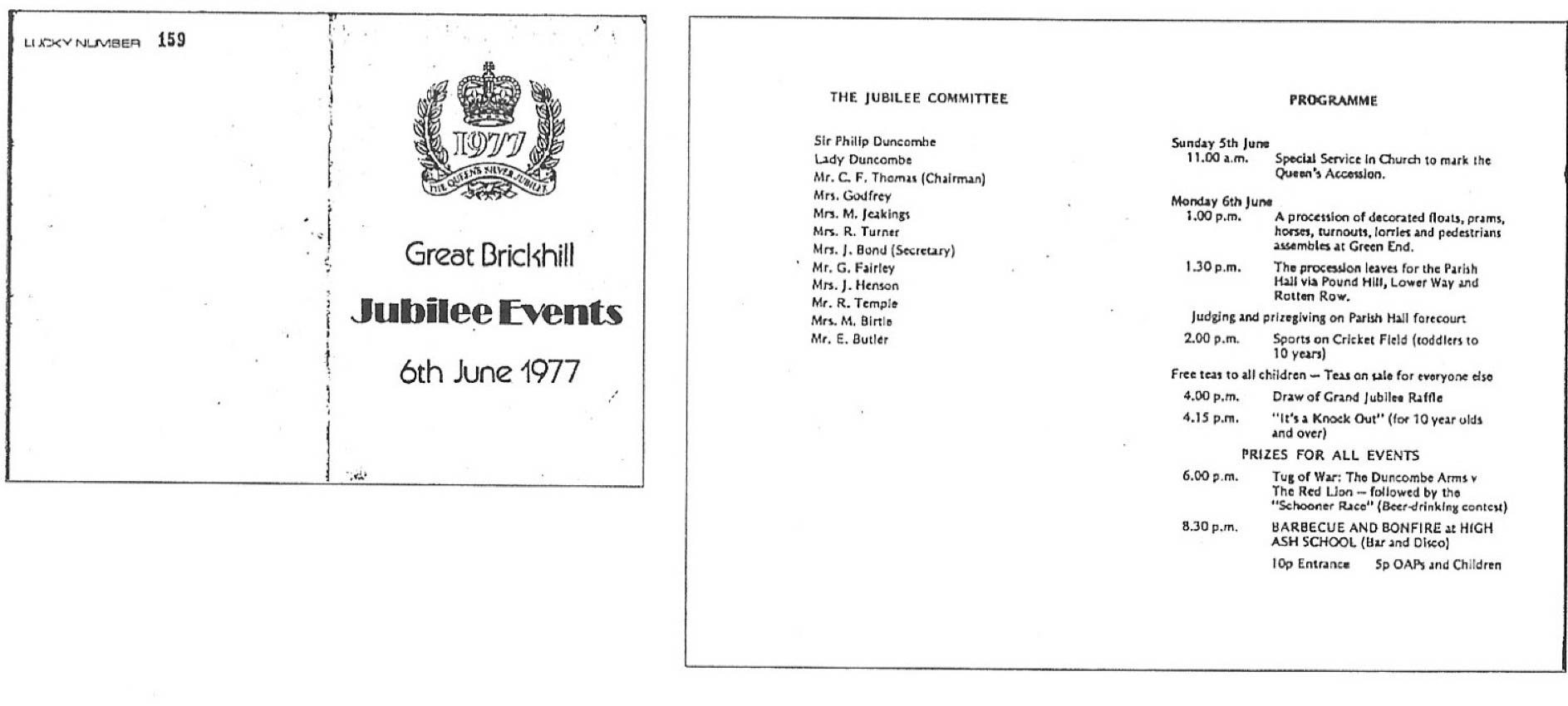
The Queen’s Silver Jubilee was celebrated after we had lived in here for one year. It was a happy day, joining in with the village community, watching the fancy dress parade of the youngsters outside the old parish hall and appreciating the time and effort given by the few volunteers to the village community, which still goes on today, twenty six years later.
A memory of being snowed out of the village, one Sunday evening in the early eighties when it was snowing. On our return, we had to be hauled out of a drift on the old A5 roundabout, by a tractor and were towed back from the Great Brickhill Road by the police, who said that snow had drifted as high as the hedges and we couldn’t possibly get through. The whole family, mother, father and three daughters had to stay at a Bletchley bed and breakfast until the next mid morning, before we could get home to our dog. It proved to be an expensive night out to the concert!
A more recent memory was the delightful re-enactment of the Nativity at the village inn, Bethlehem, 2001.
I am thankful for the lovely country atmosphere, the beautiful views for miles around from our back garden, on top of the hill. The glorious sunsets from our western, panoramic view. The large assortment of birds in the garden, especially the pretty coloured, small ones, who empty the feeder, by the window, of seeds every day and accompany us in our gardening with their beautiful singing.
The mallard duck and his mate who occasionally appear for a swim on the pond and the heron who comes too often for the fish. It is nice to see the animals through the window… squirrels, a hedgehog, badgers at night but the moles are not very welcome! The peace and quiet of the countryside… sometimes we hear more horses hooves than cars.
Editor’s Note
I remember the winter Gwyneth was talking about. The men were stranded in the village for a day. None of them could get to work. It was a holiday atmosphere.
They were jubilant at having the perfect excuse to stay at home and yet go around the village enjoying the snow. The shops profited, as a trip to the town was out of the question. The only problem was, one day later, the snow ploughs appeared, cleared the roads and the holiday was over!
My Own Memory
It was March 254, 1970. The temperature was freezing and it had started to snow. Our house greeted us with an overgrown garden and dilapidated dwelling. It had been empty for over a year and as we attempted to raise the temperature above 32 F we discovered that the Rayburn was broken and another monstrosity of a boiler, in the sitting room, was also out of action.
We had spent the previous couple of weeks sweeping out one hundred years of debris from the loft, in order to half the Rentokill, fumigation bill. At last, we had arrived, cold and broke, yet drawn to this house by its lovely atmosphere, situated in a beautiful village.
More problems were manifest as the thaw came. We lay in bed and I was awoken to the sound of pouring water. Switching on the light, my eyes fell on my husband who was in a deep sleep…. his face soaked. A sound sleeper, trying to wake him proved difficult. I shook him, told him water was pouring through the ceiling, to which he muttered, “Don’t be stupid”.
In the end, I gave up and said, “Well, I’m going back to sleep but it’s pouring on you!” This brought a better response. His hand crept slowly to his face; it felt the water and then caused his brain to register that he was truly wet. The response was “Ugh!”
Slowly, the rest of his body began to wake up and move into action.
The bed was moved and the rest of the night was punctuated with visits to the loft and emptying buckets. We had stretched ourselves financially to buy our cottage and the realisation that we needed a new roof proved rather a shock, but we prayed for help. Shortly afterwards, I heard, on the radio, that Bucks County Council had planned to give substantial grants to those who needed new roofs. My phone call, to the council, brought an unusually swift response which enabled us to go ahead and replace the ailing canopy. As far as I am aware, these grants were not available for very long.
I am thankful for the Lord’s love through the happy and difficult parts of my life, for my friends and family, and for the privilege of living in such a lovely village.
Jean Staples
My memory is of my sister’s 21st birthday party on 17th April 1970, which was held at her home in Leighton Buzzard. We assembled, ready to start enjoying ourselves, when we heard the space craft was having difficulty returning to earth, so we all watched the television. When the return was accomplished successfully, with the astronauts unharmed, we had a double celebration with toasts all round, even if it was a late start to the party.
We thank God for the long life of Queen Elizabeth the Queen Mother.
Name given for the following memory, but not printed by request.
remember my family being made very welcome when we moved to Great Brickhill in January 1989.
I am thankful for the community that we live in, that it is peaceful and secure.
Joy Leonard
I am thankful for the welcome and kindness shown to me from all the people in this lovely village.
Derrick Haynes
I remember the Medieval Fair, arranged by High Ash School. It began on the Friday evening with a medieval banquet. On the Saturday, there was a parade round the village, with many adults, already attired from the night before, willing to join the children in the fancy dress. It was very imaginative and many people participated.
I am thankful for this village and the contact I have been privileged to have with the young people through Crusaders.
Carol Clements
When we first came to the village in 1986, the post office was the hub of the village, where residents could always be sure of meeting someone. At Christmas, Butler’s shop always had special fruit and vegetables, with the oranges wrapped in tissue paper.
We are fortunate to still have a village shop where children can go unattended to buy their sweets.
Editor’s Note
Anne’s shop remains much as it did in Victorian times.
The only concessions to the modern day are metric scales, (due to a European directive), and a fridge and freezer. The shop greatly enhances the character of the village.
Hew Clements aged 12
I remember going on the church summer outing. We all met together on a coach and travelled to Wicksteed Park. Our family attended at least three times and we always enjoyed ourselves; whatever Mother Nature threw at us!
JEAN GRIFFITHS
BYGONE BRICKHILL
After seven years in the Kenyan sun, We came back to Britain in ’71.
Gone were the pounds, the shillings and pence, Of those awful ‘ps’ we tried to make sense.
There was no young boy to load my trolley,
I stood there waiting – oh, what folly!
It seems impossible, but I well recall
That a £5 note bought groceries all.
We wanted a cottage with old-fashioned charm,
In a place where the children could come to no harm.
Our wishes for character we couldn’t fulfil
And we bought a new house in pretty Brickhill.
Leighton Buzzard is the nearest town,
Not very far from the Dunstable Downs.
The kids could fly kites and afterwards, too,
Could visit the famous Whipsnade Zoo.
Country life to us was new,
The village baker, who was then eighty-two,
Was up at 2.30 to bake crusty bread,
Which his wife delivered while we were in bed.
Walter, the milkman, said he would call,
It was sometimes at nine, sometimes not at all.
The problem was that he liked his drink,
And frequently into a stupor he’d sink.
Our papers were delivered by Arthur Bates.
We wanted to pay but were told to wait.
I waited and waited as months went by;
By the end of the year the bill was quite high!
The Post Office was run by Enid and Hugh,
In the shop were groceries and greenstuffs too.
I took a large basket with groceries to fill.
But why did I live at the top of Pound Hill?
The village policeman was still on the beat,
Keeping crime down was not a hard feat.
Then came the day that none of us liked.
Our bobby was told “On yer bike!”
Sadly, these things have come to an end.
Poem by Jean Griffiths
And who can tell what the future portends.
The village will grow but it remains to be seen.
Will we be just a suburb of the new Milton Keynes?
I am thankful for all the wonderful friends we have made in the village.
Anne Humphreys
I came to live in Great Brickhill in 1978. In those days the bakery in Rotten Row was a working bakery. Mr. Langler baked the bread and then he and Mrs. Langler brought the loaves round to their customers. Mr. Langler drove the vehicle and Mrs. Langler carried the bread to the door in her wicker basket… very good bread it was too!
I am thankful for the friendship and help extended to me by all my friends and neighbours in the village over the years. It is a good place to live.
Editor’s Confession
We built a six foot fence around the garden but the aforementioned ‘Plonk’ used to scathe it. On several occasions he scrambled back with one of those delicious crusty loaves that Mrs. Langler left on someone’s doorstep… Not to mention the doughnuts!
One of his more devious crimes was bringing back half a Christmas cake. Some poor, unsuspecting soul must have thought it was safe to keep the back door open.
Fortunately, Anne, it was before you came to live here!
Daphne Barker
Sadly, Air Vice-Marshal Sir Laurence Sinclair, GC, a former resident of Great Brickhill, aged 93, has recently died. He will be remembered for his kind, trustworthy nature and for the enormous contribution he made to the country during the last war.
Miscellaneous Information
Elsie Russell used to deliver the milk, in all weathers, from a farm in Stoke Hammond. During the very bad winters, she would start work at six in the morning and not finish until late afternoon. The milk would be frozen, with the tops popping, off before it ever reached the door steps.
Reg and Bunty Meacham kept the post office after the Woods and before Mr. and Mrs. Butler.
During the ’80’s and ’90’s, a peacock used to visit the village. It was never discovered where it came from but it would appear at windows, expecting to be fed. This continued for about a year and then it suddenly disappeared.
The fish and chip van, which still visits the village on Tuesday evenings, has been visiting the village for about fifty years. It is still run by the original family.
Many villagers still recall the Lodge fire which occurred on Boxing Day 1988. The occupants of the adjoining house sounded the alarm. The house was so badly damaged that eventually, it was demolished, although the neighbouring property was saved.
Margaret Thompson
My first memory of Great Brickhill was approaching the village from Little Brickhill, on a beautiful, shimmering, hot, summers day and seeing Marilyn Howson leading a number of children, riding their ponies, in single file around the bends in the road. For a moment, I thought I was in heaven. I looked over the house and garden I had come to view and knew at once that this was where I wanted to live. Great Brickhill itself proved perfect and all the approaches to the village are equally beautiful. I never fail, when returning home, to have a feeling of elation, winter or summer, glad to know I live here.
Poetic Licence
Betty Parker moved into Great Brickhill in 1953, the year she married Ken. He had bought a plot of land in Rotten Row and had built his own bungalow. Before the building commenced, Sir Everard Duncombe asked if he would mind moving the bungalow back, quite a distance, to prevent it blocking the view of Miss Mattocks, who lived in Beech Cottage, next door. Ken agreed that the proposal would be beneficial and so the building was placed several feet back. In our present climate, with the necessity for more parking, it has proved to be a very sound decision.
The day before Betty and Ken married, Miss Mattocks handed Betty a small exercise book with some poems that she had written. It is thought that the lady was quite a good age. I have included some of the poetry that she wrote because it gives glimpses, into the way of life of the village and the thinking of an elderly person at the time.
Good Wishes for Your wedding Day
It is your Wedding Morning dear, and so I give to you,
This little poem with my love and wishes kind and true;
I cannot tell what joy or pain, the coming years may hold,
But this I know, the love of God turns everything to gold.
I wish that Christ may take your hand, and be your friend and guide,
For earthly troubles will seem small, if He is by your side;
And may God’s Spirit rest on you, and give you strength to bear,
The daily troubles, small or great that must fall to your share.
I wish you for the future dear, the best that God can give,
Good health, much wealth and many friends wherever you may live.
And may three loving angels fair, named faith and hope and love,
Attend you on the upward way, that leads to God above.
Miss Mattocks
Our Village
I will tell you of our village, it is hidden far away,
From the cities noise and bustle, and the shops so bright
and gay,
We have woods and fields around us, and a really splendid view,
Greets our eyes wherever we may look, and cheers our hearts anew.
Our village stands high on the hills in such a pretty spot
And nearly every cottage here, can boast a garden plot,
Some of the houses round about are thatched and quaint and old,
But the people who inhabit them have hearts as good as gold.
We have our dear old village church, and a cross that tells the tale,
That when the war called for our best, we did not flinch or fail,
And on our peaceful Sundays, when the bells ring sweet and clear,
We go to worship in God’s House and find His presence near.
We have our Women’s Institute, where we can work and play,
Our telephones, and wireless sets, and our letters, twice each day.
Our concert room and cricket field where games are lost and won,
And where our little children play and frolic in the sun.
If winter time is dull and quiet, the summer comes again,
And in our village, as elsewhere, the sun shines after rain.
So, if sometimes, we like the change that other places give,
No other place is quite the same as our village where we
live.
Miss Mattocks
The Thatched Cottage
It has a garden in the front, this cottage I know well,
And many tenants it has had since I came here to dwell,
But now its inmates are two friends, two ladies, kind and true,
Who help us in our village life, by the kindly deeds they do.
Those wise old builders, years ago, built on the sunny side,
The casement windows to the sun, and air are opened wide,
And though the windows are not large, a splendid view is seen,
Of hills and valleys, fields and woods, in different shades of green.
On either side, the long straight path, the flowers in summer bloom,
And perfume from the roses sweet, fills every single room.
Upon the blue and bright red tiles, the dogs guard the front door, And greet you with a friendly bark if you have been before.
Whether a house is large or small, it matters not one bit,
For a home is what you make it and what you put in it.
If love and friendship reign within, and contentment is our guest,
It is the sweetest place on earth, far the brightest and the best.
Miss Mattocks
When Berry first came to the village, Rotten Row had very few houses. Opposite her was a field with Beech trees and none of the other bungalows had been built. It was just fields and hedges. There was only one house in Upper Way. She watched the bungalow being built opposite and the drive being dug out in about 1957.
Her mode of transport became a bicycle and she would join other villagers to cycle to the nearest towns.
Third London Airport Battle – Round 1

SIR PHILIP DUNCOMBE:
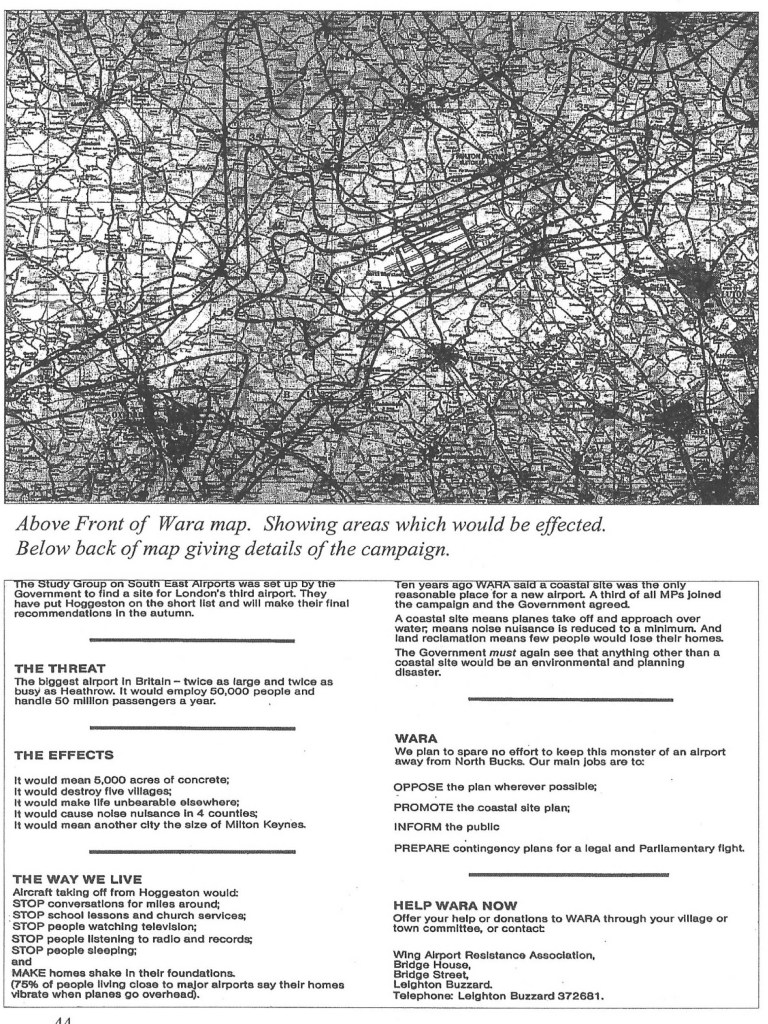
Three potential sites for a third London Airport were shortlisted in March 1969. Thurleigh (Bedfordshire), Nuthampstead (Hertfordshire) and Cublington/Wing (the site of the a former World War RAF bomber station (between Wing and Cublington.)
Wing was selected in 1970 and the Wing Airport Resistance Association sprang into action, led by Desmond Fennell in Winslow (now a retired High Court Judge).
Every possible form of fundraising was held here and in villages and towns for miles around, to raise money to pay for the experts to present our case to the Roskill Commission. Posters, placards and car stickers were everywhere – all saying “No to Wing airport. Great Brickhill would have suffered mainly from noise, with the possibility of the runway, only one and a half miles away, to say nothing of the necessary supporting buildings, road, communications etc.
The largest demonstration – over two thousand people turned up, having walked across several fields to get to the covered riding school at Wing – was addressed by eminent politicians and others, and we all joined Cleo Lane, who led singing of ‘We shall not be moved,’ which became WARA’s theme song.
There would have been one thousand, seven hundred people made homeless, and life made unbearable for ten thousand others (including the whole of the Parish). No houses were bought or sold, businesses were blighted, and the whole area was united in their opposition to what was described as ‘environmental disaster.’ The resistance association’s membership – in the final stages of the case was at least sixty five thousand and our efforts were rewarded in 1971 when Wing was reprieved.
The campaign of resistance became a worldwide topic, and was not only featured on television networks as far away as Canada and Japan, but also visitors from all over the world were made welcome all around this district.
Third London Airport Battle – Round 2
It was very hard to believe it, but in February, 1978, the search for a new Airport started again and this time Hoggeston was on the list of possible sites (three miles west of Stewkley).
The resistance Association reformed, under the same leadership, and the opposition started all over again. This time, this village was likely to suffer a worse fate than before, due to the contours of the land and likely alignment of the runway.
Hoggeston was so close to Wing that the proposals left people simply amazed and the campaign was run in an atmosphere of disbelief rather than fervour, which built up during the first threat, eight years earlier.
The Government’s final solution, this time, was to turn its attention to expanding Stanstead, where the Civil Aviation Authority already owned a lot of the land required.
Former Inhabitants
Hester Phillips (Bedford):
My parents and I moved to Great Brickhill when I was two weeks old and we lived in Rotten Row until I was ten. I had some very happy times in the village and was sad to move to Bedford for the convenience of school and my father’s job. I remember village barbecues at the Duncombe Arms and playing with other children in the
playing field, as well as going to Brownies and buying sweets at the village shop.
We lived next door to an elderly couple, who, shall we say, were not known for their love of small children. My mother took me to their home, one day, to deliver a Christmas poinsettia. Now, there was a strong emphasis in our house, on good
manners and mum and dad had always taught me to be polite to visitors. On entering our neighbour’s sitting room, I saw that the couple were watching television. I went over, switched off the set, announcing that it wasn’t polite to keep the television on when you had guests! I think my mother shrivelled on the spot. As I remember, we moved shortly afterwards!
Mary Phillips (Rotten Row, Great Brickhill. 1972-82)
On arrival in September, 1972 to the sound of rooks in the elm trees at the bottom of the garden, I remember walking our newly born daughter, Hester, in her green pram, the long way round to Mrs. Butler’s shop, in the hope of meeting someone to speak to in this deserted village.
Some years later, I recall the friendliness of other mothers from the playgroup. Their willingness (when we summoned up the courage to ask them), to form a prayer and bible study group, each week. The enormous fun and community spirit during a particularly snowy winter, sliding down the hill, at the end of the village on whatever came to hand, be it sledge, skis, tin trays or sheets of polythene.
Great Brickhill is where our daughter grew up and played freely, without fear, in the playing fields and camped with friends in the garden. It is where I found my greatest and most supportive friend (or rather she found me); where I learnt to manage without shops at the end of the road and where I began to appreciate the joys of the countryside.
(Mary now lives at Budleigh Salterton, Devon)
Stephen Phillips
I retain happy memories of garden parties, held each year, at our home in Rotten Row for members of the Leighton Buzzard Baptist Church – one of which was nearly sabotaged by my mother’s insistence on filling her washing line with a generous selection of ageing underwear!
Another drying place was found… all ended well!
(Stephen now lives at Budleigh Salterton, Devon)
Editor’s Note
By the time we arrived in the village, the two chapels had closed. A youth fellowship was held in our house, which also ran a 40 seater coach. This was used by the young people, for outings and holidays. It was a very musical affair and on special occasions, the group would go around the village singing. The gang continued for about fifteen years.
Later, the church formed Junior Quest, which sadly, has recently stopped, due to lack of leaders.
Janet Pritchard and Chris Kinchin-Smith have worked very hard with this group for many years.
Crusaders, however, is thriving and are increasing activities. Its activities include discussions, bible study, guest speakers and outings.
High Ash School
At the time of the Coronation, Great Brickhill school was still in the old building, on the corner of Lower Way and Pound Hill. In the late sixties, a new school was established. Mr. Dimmock, the head master, had taught in the old school and subsequently, transferred to the new one.
When we first came to the village, Mr. Dimmock was still the head. He was greatly respected by the school and village. Eventually, he retired and Mr. Malleson was appointed.
The school had a very relaxed atmosphere. When it snowed, each class, accompanied by a teacher would go sledding at the back of Green End. At this time, there were no fences. Anything was used to scale the slopes, dustbin bags being the most immediate resource. I remember my daughters calling in on the way back, with their friends, for hot cups of cocoa, something to eat and a dry around the wood stove. About forty five minutes later they would amble back to school with no questions asked.
Unfortunately, by the time my son attended High Ash, health and safety had taken over, followed by SATS and the eleven plus. This resulted in the school having to eliminate much of the care free life that had been such fun.

School memories from Children
Memories from children attending High Ash Today (2002)
EDITORS NOTE:
As far as possible, the following contributions remain unedited. All the contributions received were enjoyable but those chosen were included because they portrayed varying aspects of school life, over the last six years.
Thank you to all those who sent in their memories.
Fiona (age 8)
Mikvourite seemory was in class 2 when we went
to Woburn Safari Park and a giraffe stepped in front of the coach and it would not move.
Joe (age 8)
Ta year2 when we went to Woburn Safari Park, the bus
driver was in the coach and Miss Dunton opened the door but it was locked. So we went to look for him and when we came back the bus driver was sitting in the seat, waiting to go.
Francesca (age 7)
My Favourite memory is about the school play. Becky started to laugh and when Becky’s mum looked at Becky and said “No.” Becky stopped. Mary started to laugh, the only people who didn’t laugh was Odessius and his men. Georgina tripped over
Christopher’s foot and started to laugh. Then all of Time Team started to laugh. Then Mrs. Brakefield said “STOP!!! Becky and the rest stop as well.”
When we came in Mrs. Brakefield said “That was terrible!!!!”
Tom (age 9)
My memory of High Ash is when we made paper planes. Mine went the furthest out of my group.
It was a different design.
Vicky (age 9)
When I came to this school for a visit it was my first time at High Ash and I was so shy I had to sit on Mrs. Clements’s lap and in year 4, 3, and 2 she was my teacher.
Sarah (age 9)
When I left Bow Brickhill I was really sad and upset. But when I came to High Ash it made me feel really happy again.
Sarah (age 8)
My mum and dad, brother and sister went to watch me do my 800 meters. My dad had never seen me do my swimming before. I did 16 lengths and thought I was drowning.
Alexander (age 9)
I remember Mrs. Brakefield because she did really good art and because she was always nice to everyone and like Mrs. Licetus and Mrs. Clements, when we played a game we got a sweet.
Francesca (age 10)
I remember when we were in Year 1 and it was a hot sunny day. We were going swimming in the school pool. When we had been there for about 15 minutes it
started to rain. Then Mrs. Harvey came out with an umbrella for Mrs. Brakefield! After that, we got out of the pool and put our towels round us, then it faintly started to thunder and rain heavily. Some people were laughing, while some one started to cry.
Then we had to walk across the soggy grass to the class room.
Editor’s Note
My eldest daughter remembers the small round pool, more like a bucket, used initially, at High Ash, for pupils to learn to swim. All the school had to fund raise to buy the present pool. They used to swim everyday.
Jennifer (age 9)
I remember when we were in Year 4 and went on a school trip to Pizza Express. When we were testing all the different foods that could go on to a pizza, it came round to olives. When I was eating an olive, my eyes started watering because it was SO horrible. After a few seconds, I could swallow it. (YUCK! This is my memory because it was so embarrassing and everyone looked at me).
Thomas (age 10)
My memory of High Ash School was when I went to St Michael’s School in a tournament, for a cross country race. At the start everyone got to their places and the race began. The grass was quite muddy that day and at the beginning of the course I fell over into the mud, which slowed me but I still came in a good position.
Anna (age 9)
My memory of High Ash School was when I forgot my school bag and it had my lunch and my pencil case in it, so I had to borrow Jenny’s pencil and pen. At lunch time, I didn’t have anything to eat because of my bag! My mum was at work, so we couldn’t phone her up. The Good Companions concert was on, so luckily my mum was there before the concert, so she quickly rushed down the hill to get my bag and came up the hill again. I only managed to eat a sandwich before everyone else came in from play.
Christian (age 9)
I went to school but when I got there we found that it I was a teacher training day. I felt stupid. I was going to have to walk home because my mum almost left without me.
Emily (age 10)
On my first music lesson I got my trombone out. It was my turn to go first and I blew it and made a terrible noise and Tom, the other person who learns trombone, laughed and said it was a funny noise.
David (age 9)
I felt sick in Class 4. My dad came to the school, But I said I felt better but 10 minutes later fainted and they phoned my dad, so I went home.
Conrad (age 10)
My memory is when we were going to school and there was a sign on the road saying police incident. There were police men and a truck and a car upside down and wrecked. I was scared, and after fifteen minutes we were moving, but that stays with me.
Rebecca (age 10)
I remember in Year 1. We bred frogs and they escaped and they turned up in my drawer. I felt quite scared when I found two frogs inside my drawer and Mrs. Brakefield laughed.
James (age 10)
In Year 3, I was going home on a double decker bus when I heard a loud smash! I looked towards the front and screamed, just like everyone else. The front window had smashed. After about one minute we calmed down. The bus driver came up and said the window had been smashed by a tree branch. I was really scared.
Natalie (age 10)
In Reception class, Miss Austen was so impressed with the way that we held our pencils and pens that she asked Mrs. Brakefield if we could show Year 1 how to.
Mrs. Brakefield agreed, so we went in the next day and showed them how to hold a pencil or pen, it was so embarrassing.
Richard (age 9)
In Year I we were playing football and I was accidentally pushed over into a thorn bush. I had thorns in me, I was stung by nettles and I had a huge cut on my right knee. I ran up to Miss, crying. I went to try and find Miss Fish. Blood was trickling down my leg and on to the carpet. I pulled out a thorn that was in my arm. I almost had to have stitches but I didn’t. I had to go home and luckily my mum’s friend was round who was a nurse. I’ve got a scar for life!
Beatrix (age 10)
I was in Year 5 and we were doing karaoke for a Christmas party. Me, Mads and Chloe were singing “It’s raining men” by Geri Halliwell and we had forgotten the words, right in the middle, when we were performing in front of the entire class.
To make it even worse Miss Parker was filming it.
George (age 10)
My favourite memory of High Ash School was when I left my lunch on the bus and it left. I thought it was on the bus, then Shane came along with my lunch box. This sticks in my mind because it turned up when I was about to cry.
Megan (age 10)
My memory of High Ash School was when we were in Year 1 with Mrs Brakefield and Madeleine fell into the school pond in the nature area. I started to laugh with some other people and I nearly fell in myself. I felt a bit scared when I nearly fell in, but I was still laughing.
Jacob (age 10)
When I was dressed in a bear costume and I was dancing. I thought it was very funny.
Helena (age 9)
I can remember my first day at school when Mrs. Harvey took me into Mrs. Foords classroom instead of Mrs. Brakefield’s.
Jamie (age 8)
My memory is my first day at High Ash when I was sick over Nicky’s shoe.
Laura (age 9)
When Mrs. Brakefield made us take our shoes and socks off and put them on again.
Clare (age 8)
My favourite memory is when we were sitting on the bus waiting for our teacher. When she came in she turned to face the class. She said to the bus driver, “I think we are ready to go.” Then she turned around to see no bus driver.
Mary (age 8)
My favourite memory was held at Cogges Manor Farm and I was chasing a hen and his back leg nail scratched me.
Jessica (age 6)
When was in playgroup my first friend was Billy who was a girl. A long time ago I went swimming with my friend.
Victoria (age 7)
My memory is special because Jesus is God’s son. The lady was sick for twelve years. She had spent all her money going to see doctors. They tried their hardest but none could help. Jesus helped her.
Rachel (age 10)
The three cute ducklings. In Year 1 we had some duck eggs to hatch and keep until they were old enough to go back to the farm. During the time we were incubating them, one of the eggs exploded and made the whole classroom stink of rotten eggs. They hatched. Three small cute fluffy chicks. We sat in a big circle on the floor and let them out into the middle of us. They wandered round. We were so excited. The class wrote down a name to call one of the ducks. I wrote down Penn.
Emily (age 10)
My last year at High Ash I’ve got a brilliant teacher, Miss Jefferies. Miss Jefferies is wonderful, she organises trips for us all throughout the year we are here.
Also Miss Jefferies makes mainly all our lessons exciting. All our P.E. lessons are great, especially tag rugby in the winter and cricket and rounders in the summer! Miss Jefferies is great I’ve had her as a teacher in Year 4 and now in Year 6J. Miss Jefferies has planned loads of visits for us in Year 6. Our last year at High Ash, I’m going to miss my teacher a lot.
Christopher (age 10)
My best memory of Great Brickhill was the May Fair 2000, when Class 4 performed “Grease Lightening”. Every child had practised, practised and practised! Then all of the costumes came together. The performance was almost there. The whole class was ready. The May fair came. All the children were ready, walking round with their hair gelled up, and in denim jackets and jeans, and one or two in leather. Then it was time. The whole class was put under the spotlight! The music went on and the dance started! Everything was perfect apart from the introduction! The crowd went wild! HOORAY!
Victoria (age 7)
I remember the May fare because it is fun there. I like the horse rides. I like the food and the drinks. I also remember when I went on the biggest horse.
Rebecca (age 6)
I can remember when we had tadpoles and when they grew up they jumped out.
Daisy (age 6)
I remember on sports day that the blue team won. I also remember that we had to pour water in to the other end without dropping any water.
Harriet (age 6)
On my first day I didn’t want to go. I was scared. I didn’t know anybody. I wanted to stay with my mum. My first friend was Victoria. My second friend was Daisy. I made lots of friends. I was scared when I went to Vicky’s house. When my brother started he was fine. We made a video of the school. We go on the field every day
Jack (age 7)
I remember when I was playing with Pip. Pip is a robot that we control.
William (age 7)
On my fist day I can remember I was the only one crying and my teacher gave me a hug. The first person I saw was George. I can remember someone was supposed to spell plants but he spelt pants. When we played a football match we won 5-1 and I scored 4 goals.
Stephen (age 7)
I remember my first day at High Ash. When was I going home for lunch and I thought how strange it was for me. I remember my first bonfire night when the burgers were irresistible. I still remember the taste.
Jacob (age 6)
I can remember when I first got to school. My teacher was Mrs. Clements. She read us a very funny story.
Ellie (age 6)
I can remember I painted a flower at school. I was like Van Gough’s.
Rebecca (age 6)
I can remember when I started school. I can remember when Miss Gardner had a little puppet that was a mouse and she had a piglet puppet too.
Paige (age 6)
When had just started school I wanted my mummy to stay and she did. When Mrs. Clements was talking I fell asleep.
A Community To Maintain
At the present time. Great Brickhil is a thriving community. There are many facilities, with a new village hall, (we are all very thankful for the contribution made by Val Hartwell who has sadly passed away), a successful Cricket Club and the Old Red Lion, which is now managed by local people and has an excellent cuisine.
The tennis club has two courts and organises numerous events for all ages. The Women’s Institute still runs, together with Good Companions and a drop in, on a
Monday afternoon, in the village hall (the same time as the post office).
An afternoon, Thursday group meets for discussions, talks and outings. Two bible study groups meet in homes each week. The church is awaiting the appointment of a new vicar. A vicarage has just been purchased in the village, subject to contract.
The school is thriving, parking being one of the major problems at the moment.
In spite of the numerous nurseries which have been established in the area, surrounding the village, play group continues to have a large number of children and takes place in the village hall.
The village won a ‘Best Kept Village’ award last year and the three trees have had a very attractive make over, with large sand stones forming prominent features.
Although there was quite a spurt of housing development in the first decades, after the war, the last twenty five years seem to have seen a much slower expansion, (most of this has been on an in fill basis.)
Farming has seen enormous changes. Much of the land is given over to horses, set aside, country pursuits and organic production. There are only a few people able to earn a living in agriculture at present. Small businesses occupy farm buildings.
The community is still very close knit but with the pace of life, that we experience today, it may be more difficult to maintain. Jean Griffiths’ poem reminds us that we are in danger of being swallowed up by Milton Keynes. We will have to remain a very determined community in order to ensure that green fields continue to surround us.
The Golden Jubilee approaches. Clare Amies chairs the committee.
A new village band has been formed for the occasion, practising regularly at 19 Green End. All the neighbours are having a foretaste of great things.
The charities are working to set up their stalls for the event. Contributions to the entertainment are being prepared by the school and playgroup. Plans for street parties are well underway. We look forward to a memorable village occasion.
One thing is encouraging, above all else: the number of people willing to give their time and effort for the sake of the community.
GBHP Editor’s Note; This document was scanned and transcribed by hand by David Marlow in September 2023.